Few topics confuse Spanish learners more than por vs para. Both words translate to “for” in English, but they are used in completely different ways.
The good news? With a few simple rules and lots of real examples, you can master por and para faster than you think.
This beginner-friendly guide breaks everything down step by step—perfect for A1–B1 learners.
1. The Core Difference Between Por and Para
Before learning the specific rules, memorize this simple idea:
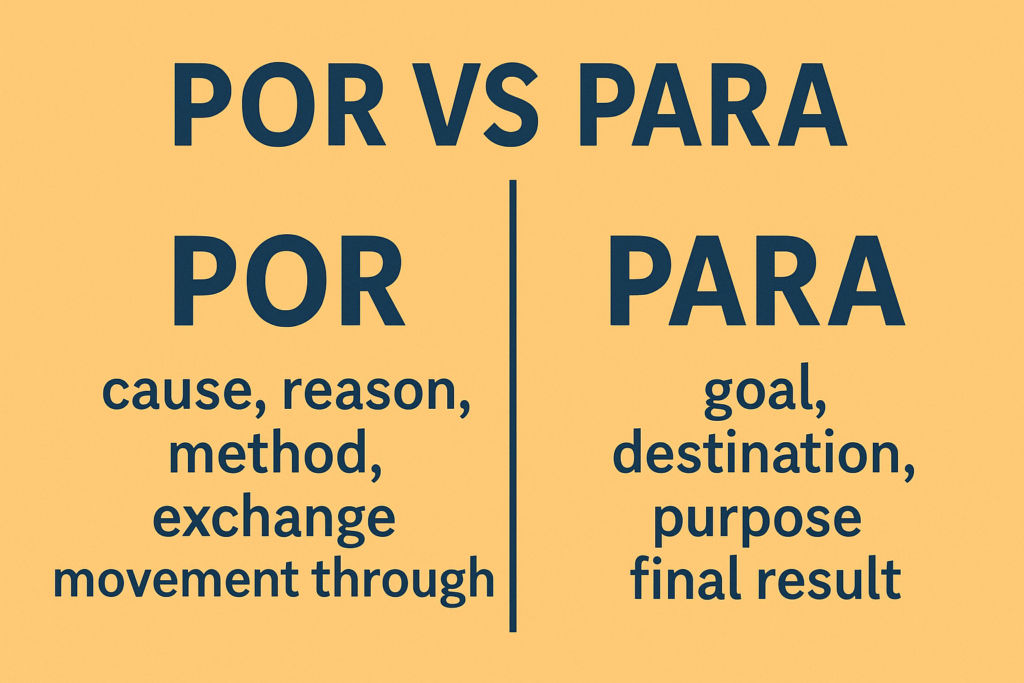
- PARA = goal, destination, purpose, final result
- POR = cause, reason, method, exchange, movement through
A helpful shortcut:
| Preposition | Think Of It As… | Simple Meaning |
|---|---|---|
| para | end point | Why? For what purpose? Where to? |
| por | pathway | How? Because of what? Through where? |
2. When to Use PARA (The “Goal” Preposition)
Use para when something has a destination, purpose, or final goal.
2.1 PARA for Purpose (“in order to”)
Use para + infinitive to express intention.
- Estudio español para viajar.
I study Spanish in order to travel. - Lo hago para ayudarte.
I do it to help you.
2.2 PARA for Destinations
Places, people, or recipients.
- Este regalo es para ti.
This gift is for you. - Salgo para México mañana.
I leave for Mexico tomorrow.
2.3 PARA for Deadlines
Due dates and time limits.
- La tarea es para mañana.
The homework is for tomorrow. - Necesito el informe para el viernes.
I need the report by Friday.
2.4 PARA for Opinions
Personal viewpoint.
- Para mí, esta serie es muy buena.
For me, this show is very good.
2.5 PARA for Employment (“works for”)
- Trabajo para una empresa internacional.
I work for an international company.
3. When to Use POR (The “Reason or Path” Preposition)
Use por for reasons, movement through places, exchanges, and methods.
3.1 POR for Reason or Motivation (“because of”)
- Llegué tarde por el tráfico.
I arrived late because of traffic. - Lo hice por ti.
I did it because of you.
3.2 POR for Movement Through a Place
- Caminamos por el parque.
We walk through the park. - Viajo por Europa este verano.
I’m traveling around Europe this summer.
3.3 POR for Duration of Time
- Estudié por dos horas.
I studied for two hours. - Voy a quedarme por una semana.
I’m going to stay for a week.
3.4 POR for Exchange or Payment
- Pagué 20 euros por este libro.
I paid 20 euros for this book. - Te cambio mi turno por el tuyo.
I’ll exchange my shift for yours.
3.5 POR for Means of Communication or Transportation
- Te llamé por teléfono.
I called you by phone. - Viajamos por tren.
We travel by train.
3.6 POR for Passive Voice
- El libro fue escrito por García Márquez.
The book was written by García Márquez.
4. Quick Comparison Table: Por vs Para
| Use Case | PARA | POR |
|---|---|---|
| Purpose | ✔ | ✘ |
| Destination | ✔ | ✘ |
| Deadline | ✔ | ✘ |
| Opinion | ✔ | ✘ |
| Employment | ✔ | ✘ |
| Reason/Cause | ✘ | ✔ |
| Movement through | ✘ | ✔ |
| Duration | ✘ | ✔ |
| Exchange | ✘ | ✔ |
| Communication/Transport | ✘ | ✔ |
| Passive voice | ✘ | ✔ |
5. Por vs Para Side-by-Side Examples
Example 1
- Estudio para ser médico.
I study in order to become a doctor. (goal) - Estudio por obligación.
I study because of obligation. (reason)
Example 2
- Salgo para la oficina.
I’m leaving for the office. (destination) - Paso por la oficina.
I’m passing by the office. (movement through)
Example 3
- Trabajo para mi tío.
I work for my uncle. (employer) - Trabajo por mi tío.
I’m working on behalf of my uncle. (in his place)
6. Mini-Quiz: Test Your Understanding
Choose por or para.
1. Este regalo es ___ ti.
2. Estudio español ___ conseguir un mejor trabajo.
3. Viajamos ___ España el lunes.
4. Caminamos ___ el bosque.
5. Te llamo ___ WhatsApp.
Answers:
- para (recipient)
- para (purpose)
- para (destination)
- por (through a place)
- por (means of communication)
7. Tips to Master Por vs Para
✔ Focus on the “goal vs reason” difference
If it answers “What is the goal?”, choose para.
If it answers “Why did this happen?”, choose por.
✔ Learn in chunks, not rules
Memorize common phrases like:
- por favor (please)
- por supuesto (of course)
- para siempre (forever)
✔ Notice context, not translation
Since both words mean “for,” translation alone won’t help.
8. FAQ: Common Questions About Por vs Para
1. What is the easiest way to remember por vs para?
Think of para = goal/destination and por = reason/pathway.
2. Do por and para always translate to “for”?
No. Sometimes they translate as “to,” “because of,” “in order to,” “by,” or “through.”
3. Is por used for transportation?
Yes—por avión, por tren, por autobús.
4. Is para used for deadlines?
Yes: La tarea es para mañana.
5. Can por and para change the meaning of a sentence?
Absolutely.
Trabajo para María = I work for her.
Trabajo por María = I’m working because of her or in her place.
6. Are there exceptions to the rules?
Yes—some expressions are set phrases, like por fin, por ejemplo, para siempre.
7. Is por ever used for future events?
Only if it describes duration, not deadlines.